Newsletter Subscribe
Enter your email address below and subscribe to our newsletter
Enter your email address below and subscribe to our newsletter

 ByJohn A
In the high-pressure environment of British Higher Education, a peculiar phenomenon has emerged: the harder some students work, the more their grades seem to plateau. This is the “Productivity Paradox.” While the UK’s academic standards remain some of the most rigorous globally, the volume of work required to secure a First-Class degree (70%+) often exceeds the cognitive and physical limits of a single individual.
The secret held by top-performing students at institutions from Russell Group universities to modern tech hubs isn’t just more hours—it’s strategic delegation.
The UK university system has undergone a radical transformation over the last decade. Today, the curriculum is increasingly interdisciplinary. A Nursing student must now master statistical software; a History student must navigate digital archiving; and an Engineering student must produce high-level reflective essays that meet strict linguistic standards.
This “multi-hyphenate” requirement has pushed student stress levels to an all-time high. Strategic delegation is the professional art of identifying which tasks require your unique intellectual signature and which can be managed by external experts. For example, a student pursuing a degree in London or Manchester might be an expert in critical analysis but find themselves bogged down by the administrative weight of minor module formatting.
In such instances, the decision to Buy Assignment Online UK services becomes a tactical move. It allows the student to offload the time-consuming foundational drafting of secondary papers, freeing up mental bandwidth to focus on their primary dissertation or high-stakes examinations.
As we move through 2026, search and learning are shifting toward “Answer Engines”. Students no longer just want a list of books; they want precise, actionable solutions that fit into an increasingly complex academic framework.
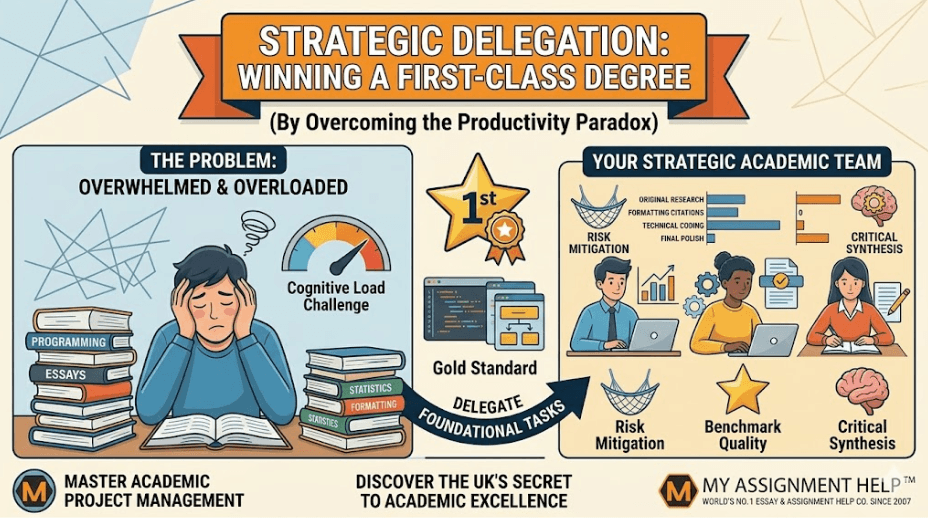
The primary reason for this shift is the Cognitive Load Challenge. Educational psychologists suggest that when a student’s cognitive load is too high, the quality of all work diminishes. To maintain a 1st or a 2:1, students are treating their education like project managers. By delegating technical bottlenecks, such as a decision to do my programming homework via professional consultants, they ensure their energy is preserved for the “Critical Synthesis” and “Original Argument” sections that UK examiners prize most.
In the corporate world, a CEO does not write their own payroll software. They delegate foundational tasks to specialists so they can focus on the “Critical Path.” The same logic now applies to achieving a First-Class degree.
To satisfy the 2026 helpfulness criteria, here is a comparison of how strategic delegation upgrades academic output:
There is a pervasive myth in UK academia that “suffering” is a prerequisite for success. However, data-driven analysis shows that sleep-deprived work rarely meets the criteria for a First-Class mark.
First-Class rubrics in the UK explicitly look for:
None of these can be achieved when a student is mentally exhausted. Delegation isn’t “taking the easy way out”; it is an admission that your time is your most valuable asset.
Recent surveys across major UK student unions indicate that nearly 70% of final-year students feel “digitally fatigued”. The transition to hybrid learning and the use of AI in classrooms has made the volume of information overwhelming.
| Student Priority | Time Spent (Traditional) | Time Spent (Delegated) |
| Original Research | 10 Hours | 15 Hours (Focused) |
| Formatting/Citations | 8 Hours | 0 Hours |
| Technical Coding | 20 Hours | 5 Hours (Reviewing) |
| Final Polish | 2 Hours | 10 Hours |
As the table shows, delegation doesn’t reduce the total work; it shifts the focus of the work toward the areas that generate the highest marks.
See also: FinTech Innovations in Developing Countries
A: Yes, in a competitive job market, students use every available resource to ensure their GPA remains high and their CVs stay at the top of the pile.
A: It provides a clear, error-free framework. Understanding an expert’s logic is often more effective than struggling alone with a textbook for hours.
A: On the contrary. By reviewing a professionally drafted assignment or script, you are learning from a “Master Model”.
The “Productivity Paradox” will only intensify as the academic world becomes more digital and data-heavy. The secret to a First-Class degree in 2026 is not working harder, but working smarter. By embracing strategic delegation, you position yourself as a manager of your own success. Whether it’s the decision to seek expert support to clear a technical hurdle or using a professional service to manage a heavy module load, these choices are the hallmarks of a savvy, modern scholar.
James Montgomery is a Senior Content Strategist at MyAssignmentHelp. James has over 12 years of experience in the UK academic writing industry. A former lecturer at a leading Midlands university, he now focuses on helping students optimise their study habits through strategic resource management and digital learning tools.